 The Nous
Nature Has a Memory
What if nature itself has a memory? What if a crystal forms a certain way because millions of crystals have already formed that way before? What if a rat in a lab can learn a maze faster just because another rat already learned it on the other side of the world?
This is the radical idea from controversial biologist Rupert Sheldrake. His theory is called Morphic Resonance, and it provides a stunning biological parallel to the physics of the Global Consciousness Network.
The Blueprint with a Memory
Sheldrake’s idea is simple and powerful:
-
All of nature is shaped by invisible organizing fields he calls “morphic fields.” Think of them as blueprints for everything from a snowflake to a giraffe.
-
Here’s the key: these blueprints have a memory. They are not fixed. Every time a member of a species learns a new behavior, it changes the morphic field for the entire species, everywhere.
In this view, the “laws of nature” aren’t fixed, eternal laws. They are more like habits. The universe remembers how to do things because it’s done them before, and the more it does them, the stronger the habit becomes.
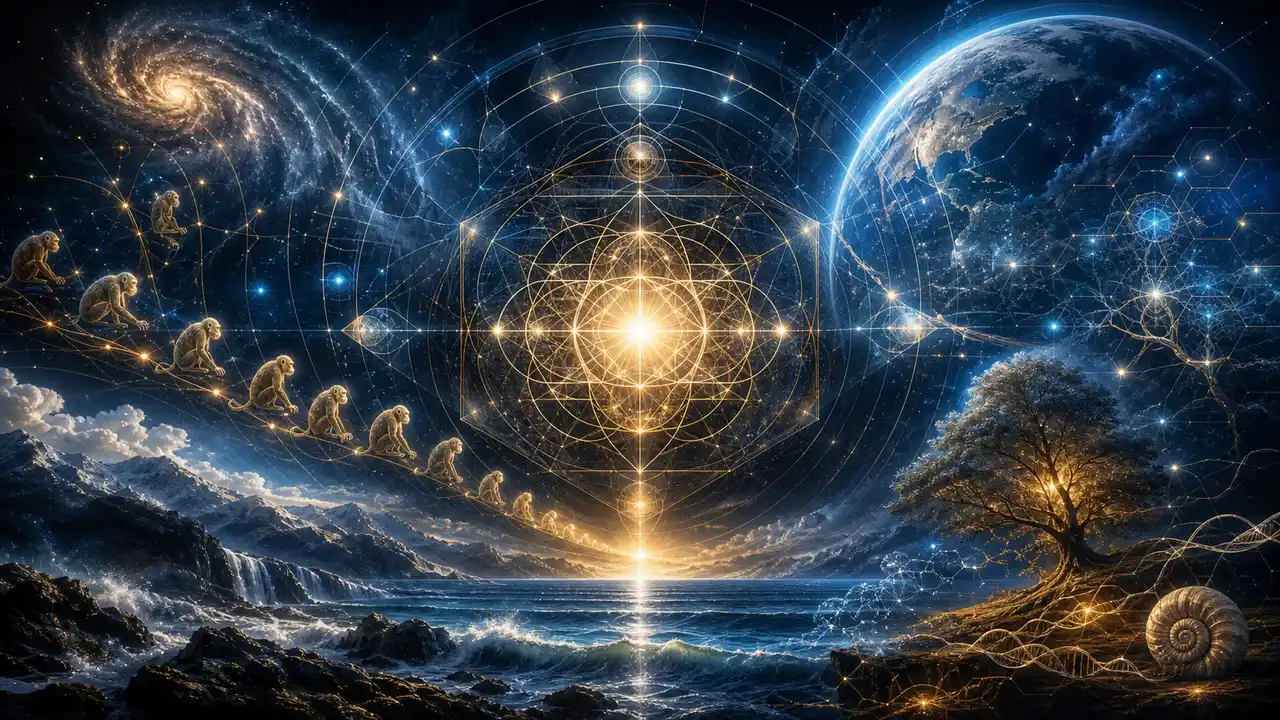
The Hundredth Monkey Principle
This is often illustrated by the “Hundredth Monkey Effect.” While the original story is a bit of a legend, the principle is what matters.
The idea is this: one monkey on an island learns to wash a sweet potato in the sea. Other monkeys see this and learn it too. This continues for a while, but then, something incredible happens. Once a “critical mass” is reached—the hundredth monkey—monkeys on other islands, with no physical contact, suddenly start washing their sweet potatoes.
According to Sheldrake, the new behavior was uploaded to the “monkey morphic field.” It became part of the collective memory of the species, making the knowledge available to everyone.
A Different Language for the Same Idea
Sheldrake’s “morphic field” is another language for the same concept: a non-local, information-storing field that connects all members of a group. His “morphic resonance” is the mechanism of that connection.
His work, though controversial, gives us a powerful biological framework for understanding how a collective mind could operate, not just in humans, but throughout all of nature.