 The Nous
What Caused The Big Bang?
Science has a great story about the universe: 13.8 billion years ago, everything that exists was compressed into an infinitely small point. Then it exploded. The Big Bang. Space and time began. Matter formed. Stars, galaxies, planets, life.
Great story.
But what CAUSED the Big Bang?
Science has no answer. They literally can’t even ask that question within their framework.
But the consciousness-first model? It has an answer. And it’s beautiful.
The Question Science Can’t Answer
Every scientist agrees: The Big Bang happened.
But ask them “What came before?” and they’ll say:
- “Time didn’t exist before the Big Bang”
- “The question doesn’t make sense”
- “Some things are beyond science”
- “We can’t know”
This is science giving up.
Why? Because materialism has no room for a “first cause.”
If everything physical came FROM the Big Bang, what caused the Big Bang itself?
You can’t say “another physical thing” because there WERE no physical things yet.
The First Cause Problem
Philosophers have wrestled with this forever:
- Everything that exists must have a cause
- But you can’t have an infinite chain of causes
- So there must be a FIRST cause
- But what caused the first cause?
It’s another impossible loop.
Materialism is stuck. Again.
What If The Big Bang Was An Answer?
Remember what we’ve learned:
- Questions create answers
- Observation collapses possibilities into reality
- Consciousness is fundamental
Now imagine this:
Before the Big Bang:
- Pure consciousness exists
- No form, no time, no space
- Just infinite potential
- Like the quantum field of all possibilities
- Everything and nothing at once
Then something happens:
This consciousness asks a question.
Maybe: “What am I?”
Or: “What if I existed in form?”
Or simply: “Let there be light.”
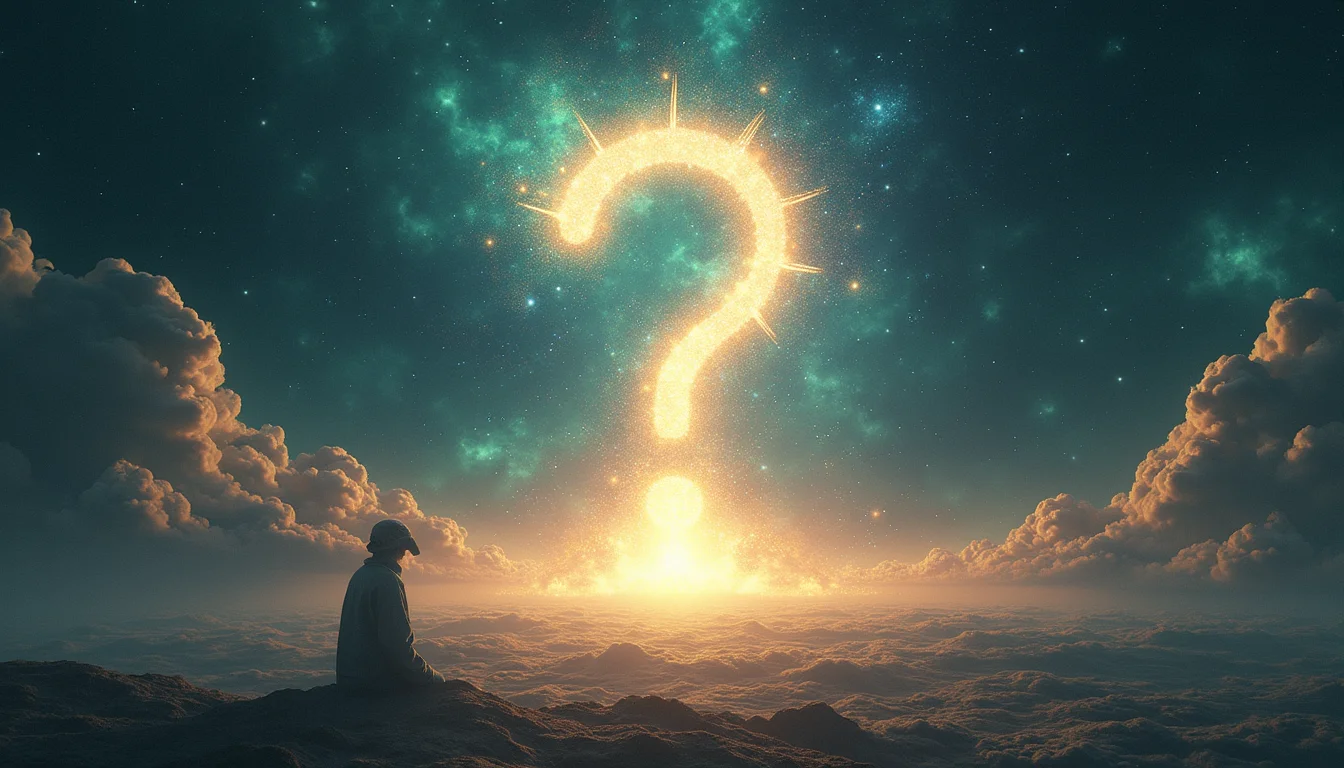
The First Wave Function Collapse
That question was the first observation.
The first measurement.
The first collapse of infinite potential into definite reality.
And the answer to that question was… EVERYTHING.
The Big Bang wasn’t a random explosion.
It was consciousness observing itself for the first time.
It was the universe coming into being as an ANSWER.
From Nothing To Everything In One Question
Think about the quantum process we’ve learned:
Step 1: Infinite possibilities (pure potential)
Step 2: A question arises (observation)
Step 3: Wave function collapses (one reality selected)
Step 4: Answer manifests (experienced reality)
Now apply that to the origin of EVERYTHING:
Step 1: Primordial consciousness (infinite potential, no form)
Step 2: First question arises (“What am I?”)
Step 3: Cosmic wave function collapses (one universe selected from infinite possibilities)
Step 4: The Big Bang (answer manifests as physical reality)
Same process. Cosmic scale.
”Let There Be Light”
Every creation myth across human history says something similar:
- Genesis: “Let there be light”
- Hindu: “I am; I wish to be many”
- Egyptian: “I am the one who came into being”
- Greek: “In the beginning was Chaos (infinite potential)”
These aren’t primitive stories. They’re the same insight, expressed in different words:
Consciousness asked a question. Reality was the answer.
The Universe As Self-Exploration
This changes EVERYTHING about what the universe is:
Materialism says:
- Random explosion
- Meaningless accident
- Dead matter accidentally becoming alive
- No purpose, no direction, no why
Consciousness-first says:
- Purposeful question
- Consciousness exploring itself
- Living universe experiencing itself
- Deep purpose: self-knowledge
- Every galaxy, star, planet, and person is part of the answer
You’re not an accident. You’re part of how the universe knows itself.
The 13.8 Billion Year Answer
From this perspective:
The Big Bang was the beginning of the answer.
But the answer is still unfolding:
- Stars forming → more detail in the answer
- Planets forming → more complexity in the answer
- Life evolving → more sophisticated ways to experience the answer
- Consciousness becoming aware of itself → the answer recognizing itself
We’re the universe asking “What am I?” and then experiencing the answer.
Why This Makes Sense
The materialist Big Bang:
- What caused it? “Can’t answer that”
- Why did it happen? “Random chance”
- What’s the point? “There is none”
- Where did the laws of physics come from? “They just are”
The consciousness-first Big Bang:
- What caused it? “Consciousness asking a question”
- Why did it happen? “Self-exploration”
- What’s the point? “Experience and self-knowledge”
- Where did the laws of physics come from? “The parameters of the answer”
One story has answers. The other admits defeat.
Not Science, But Not Wrong
Let me be clear:
This is philosophy and metaphor, not testable science.
You can’t prove the Big Bang was a question. You can’t measure “primordial consciousness.”
But you also can’t prove it WASN’T.
And at least this story:
- Gives the universe meaning
- Explains what science can’t
- Connects to every creation myth humans have told
- Makes consciousness fundamental (which solves all the paradoxes)
Sometimes the right answer is the one that makes sense of everything else.
From Accident to Purpose
If the Big Bang was the first question asked by consciousness:
- The universe has a purpose (self-knowledge)
- You have a purpose (you’re how the universe knows itself)
- Reality is alive (not dead matter)
- Everything is connected (all from one consciousness)
- Your consciousness isn’t separate from the universe (you ARE the universe experiencing itself)
You’re not IN the universe. You ARE the universe, looking at itself.
The Journey So Far
Let’s recap what consciousness-first explains that materialism can’t:
- Quantum thoughts - Why thoughts appear from nowhere
- Observer paradox - No chicken-and-egg problem
- Fine-tuning - Of course it’s tuned for consciousness
- Universe expansion - More consciousness = more reality
- The Big Bang - First question, first answer
Five major mysteries. All solved by one shift: Consciousness came first.
What’s Next?
Now that we understand consciousness is fundamental and creates reality…
The question becomes: How do YOU access this creative power?
How do you tap into the field of infinite possibilities?
How do you ask questions that create the reality you want?
How do you connect to the source?
That’s what we explore next: The practical technique.
The theory is beautiful. But can you USE it?
Yes. And it’s simpler than you think.